
We are pleased to announce the launch of the “Latin American Intellectual History Series”a joint initiative of LASA Press and Prismas Ediciones (Centro de Historia Intelectual, Universidad Nacional de Quilmes).The series is part of LASA Press’s existing collection, “In Translation: Key Books in Latin American Studies,” with a more specific objective: the translation into English of works relevant to the field of Latin American intellectual history.
The first book in the series is the English version of the seminal work by Argentine author Claudia Gilman, Between the Pen and the Rifle. In this work, Gilman analyzes Latin American intellectual life during the “fourteen prodigious years” spanning from the Cuban Revolution of 1959 to the fall of Salvador Allende’s government in 1973. The author examines the functioning of the cultural market, the connections between literary genres and social transformations, and, in particular, the vicissitudes of magazines, which reflect different facets of literary and cultural life.
The second book is Modernity and Independence, by François-Xavier Guerra. Considered by many as the definitive turning point in nineteenth-century Latin American studies, the publication of this book marked a “before and after” in Hispanic American historiography. Through ten masterful essays, Guerra offers a comprehensive reinterpretation of the revolutions that shook Hispanic America between 1808 and 1825. The central thesis of Modernity and Independence is based on the radical transformation of social and political imaginaries triggered by the Napoleonic invasion of Spain in 1808. By approaching the revolutions as a complex and multidimensional phenomenon within a shared Euro-American cultural space, Guerra explores the tension between “tradition” and “modernity,” rethinking how individualism, sociability, and the public sphere redefined the Latin American world.
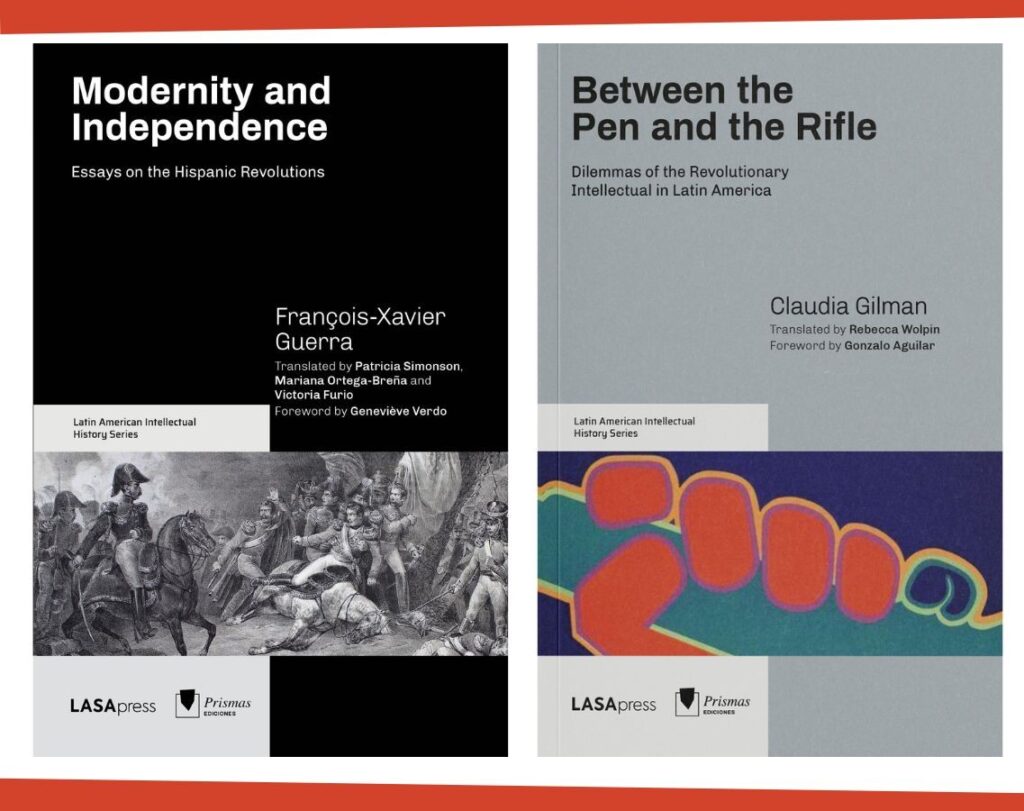
About "Latin American Intellectual History Series”
In keeping with the long tradition of the Centro de Historia Intelectual, the series defines this field very broadly as the historical study of the symbolic dimension of social life. It is an inclusive definition of diverse traditions, embracing varied perspectives, from coneptual history to history of ideas, from the sociology of intellectuals to cultural history, among many others. This includes the study of ideas considered as acts of discourse, ideological languages, and works of thought and artistic expression, seeking to examine how these elements intertwine in the social fabric, and tracing the trajectories of intellectuals and their institutions. The approach seeks to integrate the intrinsic meaning of the works and their materiality: the textual or physical formats through which ideas are produced and disseminated. It may also include the study of more diffuse cultural dimensions, such as social imaginaries, collective representations, and urban cultures.
The series seeks to bring together works already considered fundamental for their contribution to understanding the cultural life of the continent, alongside more recent, innovative works that challenge and renew the methodologies of intellectual history, and promotes their circulation in English to broaden their international reach. Furthermore, these are open-access books available free of charge.
The editorial board for this collection consists of Natalia Majluf (LASA Press), Cristina Soriano (LASA Press), Laura Ehrlich (Prismas Ediciones), and Adrián Gorelik (Prismas Ediciones).